
Hypcars of the 1970s

What an exhilarating decade for hypcars! Not only did Citroën continue the legacy of the iconic DS, which had been in production for a remarkable 15 years, but it also launched the small (but great!) GS and the singular SM in 1970, followed by the DS’s heir, the CX, in 1974. Then, in 1975, Mercedes-Benz introduced a system called HPF (Hydropneumatische Federung), with upgraded versions HPF II in 1981 and HPF III in 1986 (see the image on the right). This system was inspired by Paul Magès’s original hydropneumatic design; however, unlike Citroën, which utilised a single pump for the entire hydropneumatic circuit, Mercedes opted for separate pumps dedicated to braking, power steering, and suspension. Earlier models, such as the Mercedes W109, featured air suspension, but the first true Me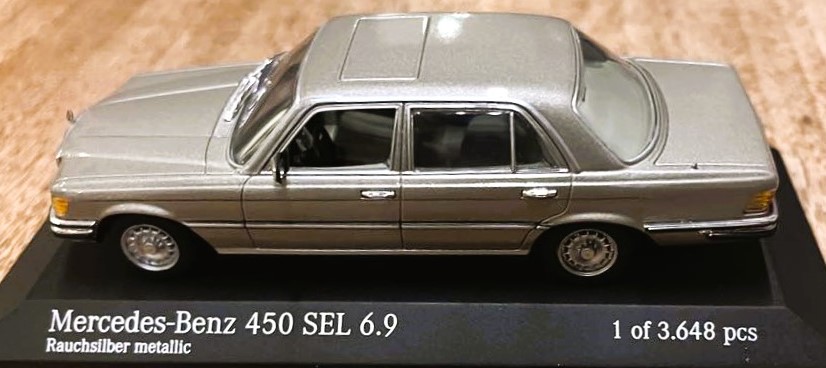 rcedes hypcar was the 450SEL 6.9 from the W116 series (see photo of an equally rare miniature on the left). From there, we saw a variety of models from the W123 and W126 series, including the 420/500/560SE(L) and later the E-series, all offering the option of rear-wheel hydropneumatic suspension. BMW also got on board, providing hydropneumatic spheres with a height corrector as an option for the rear suspension of their 3, 5, 6, and 7 series.

Innovator Alex Moulton took things up a notch with the Hydragas suspension system (picture on the right), which replaced the earlier Hydrolastic units with metallic (hydropneumatic) spheres. The Austin Apache (1971-1977), known as Victoria in Spain, along with the Austin Maxi (1969-1977), were the last BL models to sport Hydrolastic suspension. The novel Hydragas system was first introduced in the Austin Allegro, and later featured in the Austin/Morris/Wolseley 18–22 series, eventually renamed Princess and also known as “The Wedge.” At some point, British Leyland (BL) even experimented with a fully hydropneumatic Rover P7 prototype, which, sadly, never made it to production!
Meanwhile, Maserati, under Citroën’s leadership, crafted the rare Quattroporte II with a full hydropneumatic suspension inherited from the iconic SM. Rolls-Royce wasn’t far behind, incorporating Citroën-style rear suspension spheres in the sumptuous 531 Camargue models produced from 1975 to 1986. Bentley followed suit with its T series, while Land Rover combined springs, progressive bump stops, and the innovative Boge Hydromat “self-energising levelling device” in their Range Rover, which would eventually evolve into the ZF Nivomat. Finally, we cannot overlook the extravagant Aston Martin Lagonda, produced from 1976 to 1990, which also featured a self-levelling suspension in the rear axle.