
The C6 in Brief
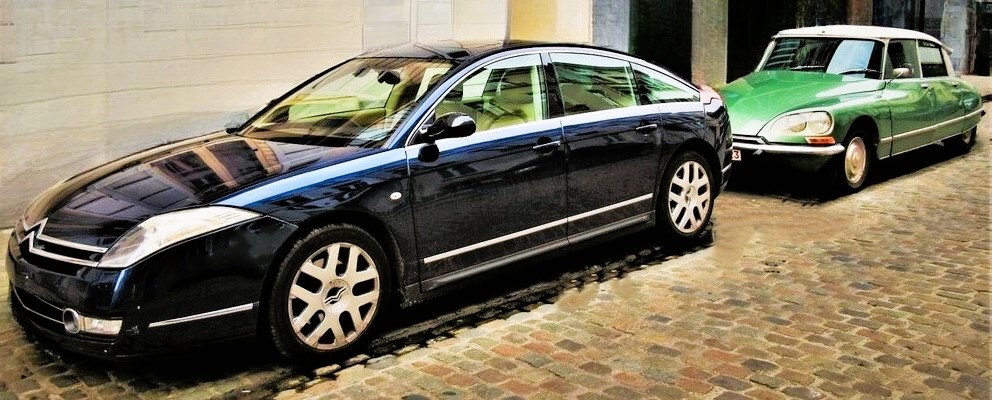
The C6 marked the grand finale of Citroën’s executive hypcars in 2012, while the smaller C5 III X7 kept the hydropneumatic suspension alive until 2017. The C6 emerged as the largest hypcar ever made, launched exactly 50 years after the iconic DS and a staggering 75 years after the original 1929 Citroën C6. Its name and design also pay tribute to the CX.
These connections were no mere coincidence; the C6 aimed to modernise its illustrious predecessors, with the ambition to dazzle in elegance, comfort, and safety. And it certainly delivered, as shown by its impressive highlights:
-
Hydractive 3+ Suspension (aka AMVAR): This top-tier electronically controlled hydropneumatic suspension system delivers an unrivaled ride by automatically adjusting its firmness, damping, and ground clearance based on speed and road conditions.
-
Cutting-edge safety features: Among its impressive arsenal were innovative active safety features like aircraft head-up display technology that projected vital information directly onto the windscreen, and the first-ever lane deviation warning system (AFIL), which even vibrated the driver’s seat if the car wandered across a white line without indicating! With a whopping nine airbags and a stellar five-star rating for occupant protection in front and side impacts, the C6 meant serious business when it came to safety.
- Pedestrian protection: This was the first car to achieve four out of four stars for pedestrian safety, featuring a pioneering system with a bumper that raises the rear
 part of the bonnet when it detects a collision, thereby creating a cushion of space to protect a pedestrian’s head. Just for comparison, its younger sibling, the Citroën C5, only managed a meagre two stars (see the green and red areas in the accompanying photo).
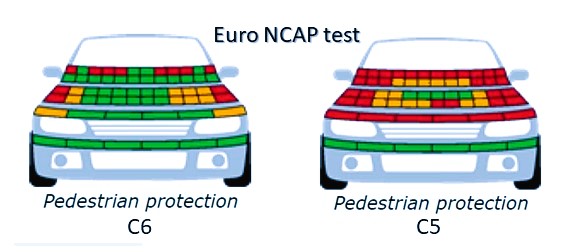 part of the bonnet when it detects a collision, thereby creating a cushion of space to protect a pedestrian’s head. Just for comparison, its younger sibling, the Citroën C5, only managed a meagre two stars (see the green and red areas in the accompanying photo).
Visually, the C6 broke free from the endless sea of robotic car designs that dominated the early 2000s. I dare say it was almost as stunning as the DS back in the 1950s! At the same time, it presented a smart and cohesive style with a three-volume body cleverly disguised in a two-volume outline. Overall, it boasted a streamlined silhouette that resulted in a low (though not flabbergasting) aerodynamic drag coefficient of 0.31. Following in the footsteps of the CX, the C6 featured an even more pronounced concave self-cleaning rear window, designed to sweep away water droplets with finesse. Its uniquely styled rear end also included a retractable active spoiler. A throwback to the DS and SM models was the return of turning beams and frameless windows.

The Hydractive 3+ suspension employed state-of-the-art electronic control for both springing and damping. But if you preferred a firmer ride, you could easily override the system and manually switch to a stiffer suspension mode. The system adeptly adjusted the vehicle’s ride height, either automatically or manually, based on your speed and the condition of the road. Enhancing its reliability, Citroën introduced new “slimline” suspension spheres (see the photo on the right!) paired with an entirely synthetic suspension fluid known as LDS. This specially engineered fluid was designed to resist oxidation and had an impressive lifespan of ten years before requiring renewal. The result of all these updates to the hydropneumatic suspension was increased reliability and safety.

Following in the stylish, safe, and comfortable footsteps of its predecessors—the DS and the CX—the C6 stepped up as the official car of the French Presidency. Citroën went above and beyond for its VIP C6 clients, commissioning a bespoke garage from architect Neutral, complete with fibre optics and LCD screens. This futuristic garage allowed owners to switch between “expose” and “hide” modes (see drawings on the left). It is no surprise that the C6 earned the title of “Best Rolls-Royce Alternative” at the 2006 UK “What Car?” Awards—a serious accolade in its own right!
So, what led to the C6’s commercial flop? The more than five-year delay between the reveal of the Lignage prototype at the tail end of XM production and its official launch in 2005 likely played a part. As J. Broustail notes in Citroën et le citroënisme, its Japanese and German competitors had, in the meantime, been inspired by the Lignage (e.g., the third-generation Lexus GS and the first-generation Mercedes CLS), and even Citroën had launched the C4 and, in 2007, the ultimate C5 generation, which resembled the C6’s design. Additionally, during the transition into the 21st century, attitudes and trends evolved dramatically, particularly regarding individualism and privacy. As P. Verges notes in Citroën les plus authentiques 1936-2006, the C6’s expansive and transparent windows felt overly exposed compared to the more discreet German luxury offerings, leaving its interior wide open to curious onlookers. Finally, younger buyers found the C6 bulky and somewhat conservative, while, on the contrary, Citroën’s loyal fanbase felt it leaned too heavily into modernity and, without offering an estate version, nudged them towards German saloons instead. Once again, like its predecessor, the XM, Citroën’s flagship struggled against its German rivals due to poorly timed market positioning and a disconnect in target demographics.
In the end, the C6 was a celebration of Citroën’s innovative spirit and design legacy, but it came out too late. I can’t help but recall a comment from a Top Gear journalist who dubbed the C6 “a fantastic-looking car with a philosophical approach to luxury,” although they sadly predicted its commercial downfall. Looking back, it seems that the limited production run of the C6 will only enhance its classic status—a reality that is bound to emerge over time. After all, we’re talking about the final chapter in the legendary lineage of flagship Citroën hypcars, where even the legendary DS was not the first!
C6 Interesting Facts and Figures
-
The C6 was Citroën’s last flagship hypcar, making its debut in 2005, exactly 50 years after the iconic DS, and graced our roads until 2012.
-
The production car was based on the stunning “Lignage” prototype, unveiled six years earlier and crafted by Marc Pinson under the expert guidance of Art Blakeslee and Jean-Pierre Ploué. It featured an aerodynamic drag coefficient of 0.31.
-
The C6 came with four engine options: 2.2-litre, 2.7-litre, and 3-litre diesel engines, along with a lively 3-litre petrol variant.
-
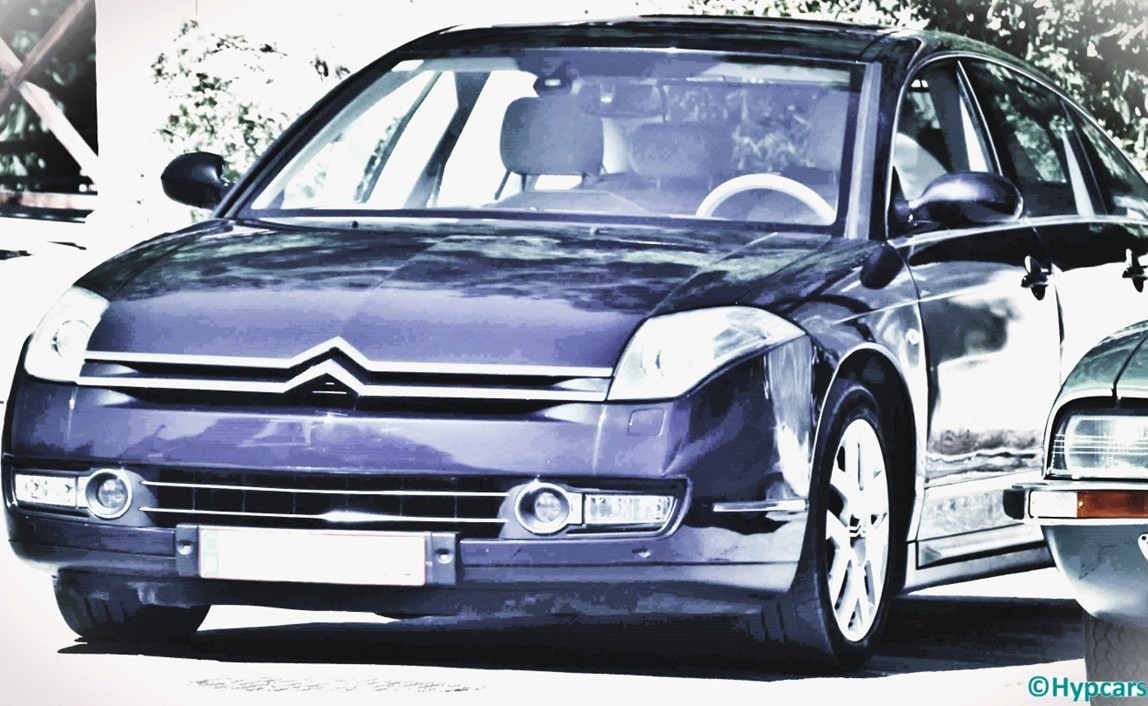
Citroën’s dreams of the C6 skyrocketing in sales didn’t quite materialise, with a limited production of 23,000 units. Out of these, 13,081 C6 models were equipped with the 2.7 HDi Biturbo diesel engine, as the model in this collection, which dazzles in Mauritius Blue Mica (colour code KPK).