
Driving Experiences


Now, buckle up for a thrilling ride! As you settle into the driver’s comfy seat, you’ll immediately notice the unmistakable Citroenesque design, highlighted by the legendary barrel-like dashboard controls, affectionately dubbed “satellites,” alongside a sleek, futuristic instrument panel. Getting the engine going might take a bit of manual choking, especially on those brisk mornings, and the roar you’ll hear will make you imagine a muscled 2CV rather than a small DS. After a few kilometres, the quirky switch arrangement around the wheel begins to make perfect sense, revealing just how practical it really is. You can operate all controls without ever needing to take your hand off the wheel! Even the handbrake is smartly located on the dashboard, perfectly within reach. But let’s not forget automotive history, as the rare Toyota 2000GT set the trend three years earlier with its own dashboard-mounted handbrake.
While the seats in the GSA are undeniably comfortable, taller drivers over 1.85m may find the lack of height adjustment a bit challenging. The front seats have limited backward movement, and the non-adjustable steering wheel adds to the complexity—just a gentle reminder that previous generations weren’t quite as tall! On the flip side, rear passengers enjoy ample legroom, and with its soft seats, the GSA stands out as one of the coziest small saloons available.
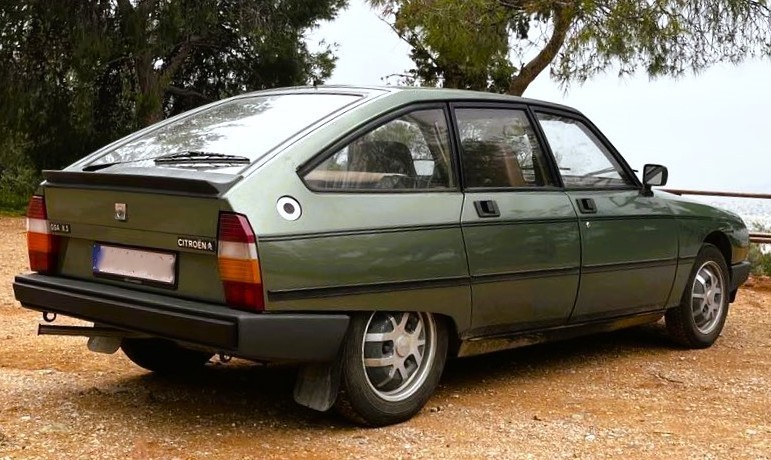
We have crossed Europe from north to south twice with the GSA, driving non-stop for 3 500 km non-stop. We put the air-cooled “flat four” engine to the test in heavy traffic and sweltering Mediterranean heat, and it just refused to overheat! Now, when it comes to motoring and mechanical noises, the GSA doesn’t quite meet modern benchmarks, mainly due to its outdated sound insulation. Still, the absence of engine vibrations at idle makes you eager to twist the key and fire up the engine! Visibility is generally excellent, except for the right exterior mirror, which is partially obstructed by the right A-pillar—much like the Series 1 XM.

Thanks to its neutral front suspension geometry, the GSA’s non-assisted steering is very direct, accurate, and easy to handle when you’re on the move. However, parking or manoeuvring can be quite a workout. While a lack of power-assisted steering was standard 50 years ago in this category, by today’s standards, it can pose quite a challenge for your muscles, especially for those who aren’t regular gym-goers! It serves as a clear reminder of how our dependence on comfort has evolved, much like our reliance on air conditioning, making anything that requires physical effort feel somewhat unfamiliar. And let’s not forget, A/C was never an option with the GS/GSA.
The small hypcar’s performance is nothing short of astonishing, with its responsive brakes and nimble steering making it easy to weave through today’s traffic. The braking power rivals that of its bigger brothers, the DS and the SM, thanks to the hydropneumatic suspension and the inboard front disc brakes. Just a heads-up, though – back in the day, ABS was a luxury that wasn’t yet available, so watch out for early wheel lock on slippery roads. On the upside, the anti-dive front suspension geometry is a game-changer, keeping the softly suspended hypcar steady and composed, even under heavy braking. Last but not least, the GSA can be converted into an off-road vehicle by increasing its ride height by more than 10 centimetres.
Overall, our time behind the wheel of the GSA is always an absolute thrill! This standout hypcar is a marvel in the small-to-medium-sized car category. At its peak, it left all its competitors in the dust and can still hold its own against many modern vehicles.
