
Hypcar Oddities
After singing the praises of the incredible hydropneumatic systems in hypcars, some may still scoff, “Alright, alright, but apart from their mind-blowing suspension that effortlessly adapts to load and road conditions, allowing for a height adjustment of some 20 cm, their impressive steering and braking capabilities, and their knack for balancing comfort with handling, what have hypcars ever really given us?” To answer this cheeky, Monty Python-esque query, we shine a spotlight on the remarkable quirks of hypcars, particularly those hailing from Citroën. These vehicles are bursting with innovative features that exemplify forward-thinking and cutting-edge design, making significant strides in aerodynamics, safety, and comfort while boasting a stylish and efficient profile.

In a departure from most manufacturers of the time, Citroën’s hypcars were not only exclusively front-wheel drive but also carried nearly 70% of the car’s weight on the front axle. They exhibited a teardrop shape, easily recognisable from both the side and above, though to varying extents depending on the model. The narrower rear track bolstered overall balance, while semi-closed rear wheels and skirted wings effectively reduced turbulence and air resistance. These features sculpted a streamlined rear, accentuating the vehicle’s forward momentum. Unlike the pushing force seen in models like the Porsche Turbo and American muscle cars, the pulling effect of these hypcars is well-researched and beautifully depicted in “The Goddess – La Deesse: Investigations on the Legendary Citroën DS” by C. Sumi. The tapering at the rear measured 20 cm for the DS and the SM, 11 cm for the CX, 8 cm for the GS/GSA, 7 cm for the XM, and 3 cm for the C6. This difference between front and rear crafted a silhouette akin to that of a lithe athlete, with a powerful upper body and a sleek lower body, harmonising strength, stability, speed, and agility!

A vehicle’s aerodynamics is crucial for boosting performance and fuel efficiency, enhancing safety—especially regarding wheel grip and stability against crosswinds—and improving comfort by minimising wind noise. Citroën has been at the forefront of this technology for decades. One of the most striking aerodynamic features of Citroën’s hypcar lineage, beginning with the iconic DS, was the elimination of a radiator grille and the clever concealment of air intakes, giving each car a unique look reminiscent of zoomorphic muzzles that exude vibrant personalities. Additional aerodynamic elements in Citroën hypcars included seamless wings, sealed front arches, and a sleek underbody, all contributing to a remarkably streamlined design. While many of these features have since become standard in modern vehicles, they were groundbreaking when introduced 70 years ago. The table below demonstrates how Citroën hypcars consistently achieved some of the best aerodynamic figures for their time. It showcases the cars’ drag coefficient (Cx), determined by their shape, as well as their overall aerodynamic resistance or drag area (CxA), which is the product of Cx and the car’s frontal area (A), influenced by the car’s dimensions. This helps clarify why, for instance, the GSA X3, despite having a less favourable drag coefficient than the XM, still holds the record for the lowest air resistance among hypcars.


Another impressive feature of the Citroën DS, SM, and GS hypcars was their ingenious front-wheel neutral steering geometry. The spindle steering arms were expertly articulated at the centre of the wheels, as illustrated in the picture on the left. This design allowed the front wheels to pivot with a null offset (zero scrub radius) around their vertical symmetry axis. Regardless of speed, the wheels could accelerate, brake, steer, and glide over obstacles without impacting the steering and trajectory, thanks to the elimination of the gyroscopic steer bump. This feature even played a pivotal role in saving the life of French President De Gaulle during an assassination attempt in 1962. While the principle appears simple, its implementation is quite complex, as it requires separating steering from braking (as evidenced by the DS/GS/SM’s use of inboard front brakes), which may explain why it wasn’t adopted in later models. Interestingly, although Mercedes embraced this approach in 1972 with the W116 series, Citroën abandoned it in the early 1990s with the end of CX production.
Hypcars achieved an exceptionally low centre of gravity through the use of lightweight materials and specialised design techniques. Both the DS and SM featured aluminium bonnets, while the DS also sported a fibreglass roof. Additionally, the DS, SM, and C6 came equipped with frameless windows.

Citroën hypcars have earned a reputation for their incredible balance and stability, showcasing an almost uncanny ability to be driven on three wheels, as demonstrated in the photos and videos below. They have even achieved rally victories, as seen in the photo on the right!


That remarkable stability can be attributed to a generous wheelbase, which, when paired with an extended front overhang and a much shorter rear overhang, crafts a distinctive front-loaded two-volume design (see pictures on the right). The long front overhang is especially striking in the C6, featuring a jaw-dropping overhang that extends more than 110 cm beyond the front track. On the other hand, the short rear overhang cleverly positions the wheels directly under the boot, avoiding the intrusion on rear doors that is common in many other vehicles. The result? Increased space for rear passengers and elegantly shaped rear doors. Additionally, the absence of a transmission tunnel inside means a wonderfully spacious interior, offering a virtually flat rear floor.

Innovative features like swivelling headlights were a hallmark of the Citroën DS, SM, and C6, turning in sync with the wheels. This fantastic functionality significantly improved visibility around corners at night, enhancing safety like never before. Depending on the model, the headlights were always neatly oriented horizontally, powered mechanically (DS), hydraulically (SM), or electronically (C6), effectively compensating for any pitch movements of the car.
Before airbags made their debut in 1995, Citroën opted for a single-spoke steering wheel (see photos below) that not only provided drivers with a clear view of the instrumentation panel but also enhanced safety during collisions—the wheel could collapse under pressure, giving it a safety profile akin to that of an airbag.
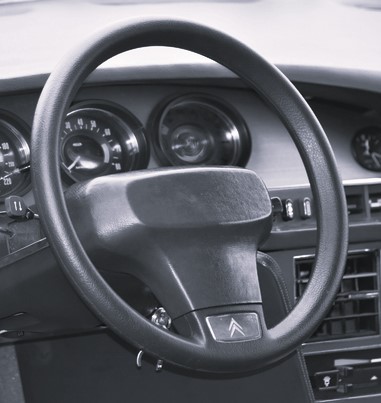


Furthermore, this design offered a better grip while manoeuvring. The famous oval steering wheel of the Citroën SM (far-right photo) still turns heads today, especially given that Toyota’s Prius, released three decades later, adopted a similar oval aesthetic. Many other brands have since adopted this design.
Apropos of the Prius, it should be noted that the design of this first mass-produced hybrid family car was clearly inspired by the Citroën GS/GSA, particularly its compact liftback form (see comparative photo below).

Did you know that in the SM, GS, and CX, the radio was positioned between the front seats instead of on the dashboard? While this might seem quirky now, remember, this was the ’70s, when tape players used rotary switches, not the buttons or touchscreens we’re all used to. This clever placement meant drivers could effortlessly tune in or swap tapes without ever having to glance away from the road.
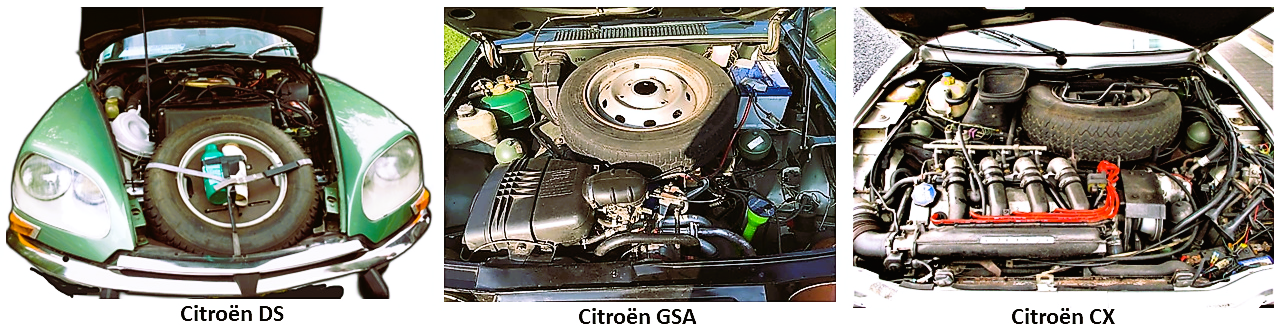
And who says the spare wheel was placed in the boot or underneath? Certainly not in the iconic DS, GS/GSA, or CX! In these legendary hypcars, you’ll find the spare neatly housed right under the bonnet (see photos below). This design not only maximised boot space but also made the spare incredibly easy to access—far better than fumbling around under the car. Some even argue that this was a safety feature designed to absorb collision energy.
Another standout feature that originated with the DS is the clever double-action boot lid springs found on certain Citroën hypcars. This ingenious little innovation allows the boot lid to be propped open at a tilt without any extra straps, making it very practical when the boot is overflowing. For a fun overview of other delightful quirks of the DS, check out Doug DeMuro’s entertaining take on his YouTube channel.
Citroën hypcars, along with certain equally disruptive creations from Mercedes, BLM, and the legendary NSU (which later evolved into Audi), marked a significant shift in saloon car innovation, both technologically and aesthetically. One could even liken them to the Teslas of their time! However, a closer inspection of the photos below reveals that some of the “originalities” found in certain Tesla models had already appeared in earlier Citroën hypcars and prototypes.

The impact of Citroën hypcars is so profound that it has influenced model names across the automotive landscape and even inspired the creation of a new brand. Just look at BMW, which named its most powerful SUV the XM and its highest-performing touring motorcycle the GS/A! Then there’s Volkswagen, launching its “ID.” electric car series, Mazda rolling out an entire range of CX SUVs, and MG also boasting a GS model. It’s hard to believe that these brands have run out of alternative acronyms for their models! Ultimately, an entire brand—DS Automobiles—was born to celebrate the legendary DS. Recent buzz from Shanghai has revealed that NIO’s flagship model, the ET9, launched in 2025, not only features a fully active hydropneumatic suspension, known as FAS, but also intriguingly draws on Citroën’s design elements, including its iconic logo, as shown in the images below. Even China’s leading bus manufacturer, Golden Dragon, has taken a moment to “celebrate” the Citroën logo!

Citroën has set the gold standard for hypcars, inspiring countless imitators along the way. Even today, hydropneumatic Citroëns leave many modern cars in the dust when it comes to ride smoothness and innovative design. The wave of emulations from other brands is a testament to Citroën’s enduring creativity and ingenuity.
.
