Hydropneumatic Basics

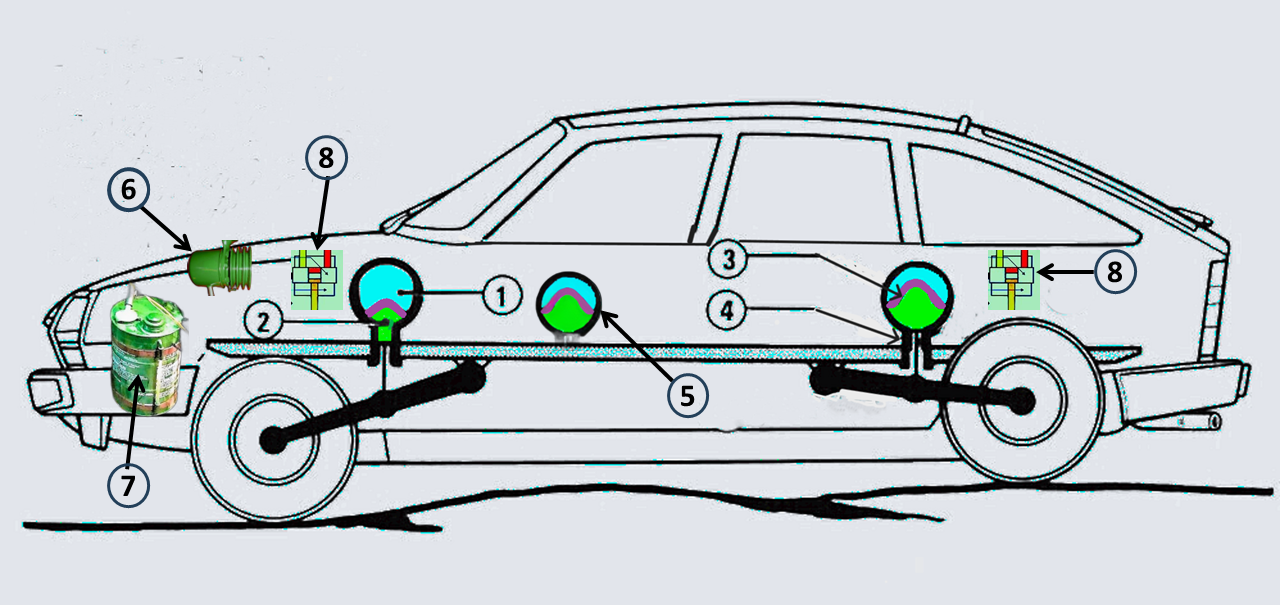
Throughout automotive history, the vast majority of vehicles have relied on classic suspensions featuring coil or leaf springs, and occasionally, torsion bars, paired with hydraulic or gas dampers. But hold onto your seats, because we’re about to dive into a game-changer: hydropneumatic suspensions! These advanced systems achieve unprecedented shock absorption through metallic spheres (see photo on the left) that are partially filled with a non-corrosive gas—specifically, nitrogen (marked as ‘1’ in the diagram below)—alongside a mineral or synthetic hydraulic fluid (marked as ‘2’ in the diagram).
.
Some Linguistics and Prehistory

Now, let’s dive into the thrilling world and history of hypcars, all characterised by their remarkable suspension systems. We’ve chosen the term “hypcar” to specifically refer to vehicles equipped with hydropneumatic suspension, which cleverly combines fluid and pressurised gas. The prefix “hydro” comes from the ancient Greek word for water, “hydor,” while “pneumatic” relates to gases. Fun fact: in Greek, “pneuma” also translates to “spirit,” adding an enchanting layer of vibrancy to this suspension type. What’s more, the early inventions of pneumatic and hydraulic engineering can be traced back to Hero of Alexandria in the 2nd century AD! Now, let’s zoom in from those Greek beginnings to the significant French contributions that shaped fluid and gas suspensions.
.
Hypcars of the 1950s

Hypcars of the 1960s

Hypcars of the 1970s

Hypcars of the 1980s

Hypcars of the 1990s

More Recently